TMJ surgery cost with insurance can vary significantly depending on the type of procedure, surgeon, facility, location, and your insurance plan. If you are researching TMJ surgery cost without insurance, the amount you pay can also vary widely because you may be responsible for most or all of the treatment costs.
Some patients may have part of the expense covered by medical or dental insurance, while others may have to pay most or all of the bill themselves.
The most important thing to understand is that the price of TMJ surgery is not necessarily the amount you will pay.
With insurance, your final out-of-pocket cost can depend on your deductible, coinsurance, copay, network status, negotiated rates, and the specific terms of your plan.
How Much Does TMJ Surgery Cost?
There is no single standard price for TMJ surgery.
The cost can vary considerably because TMJ surgery can refer to several different procedures, ranging from minimally invasive treatments to complex open-joint surgery or total TMJ replacement.
The TMJ Association also discusses the variation in TMJ treatment costs and the difficulties patients can face when determining what their insurance will cover. You can learn more from the TMJ Association’s guide to TMJ treatment costs.
Individual providers also publish different estimates. For example, Cary Prosthodontics’ TMJ treatment cost guide discusses factors that can affect TMJ treatment pricing.
Because the procedures themselves can be very different, the cost of arthrocentesis may be substantially different from the cost of open-joint surgery or TMJ replacement.
TMJ Surgery Cost by Procedure
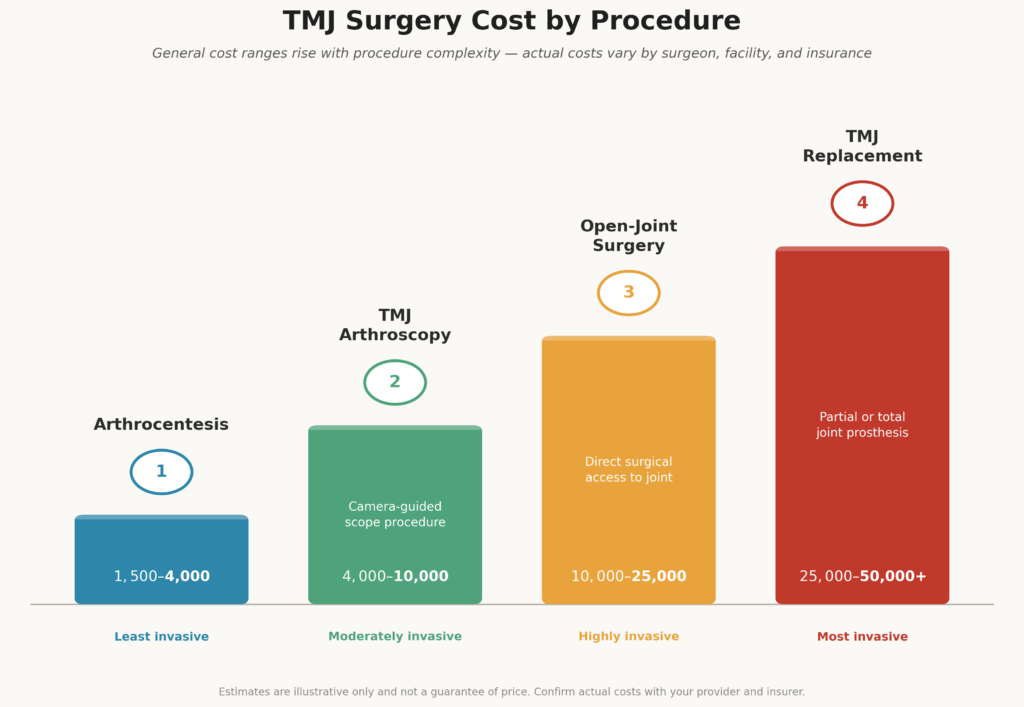
Arthrocentesis
Arthrocentesis is a minimally invasive procedure that involves irrigating the TMJ joint.
Because it is less invasive than many other surgical approaches, it may have a lower overall cost. However, your final bill can still depend on factors such as anesthesia, facility fees, surgeon fees, and follow-up care.
For another discussion of TMJ treatment pricing, see Cary Prosthodontics’ TMJ treatment cost guide.
TMJ Arthroscopy
TMJ arthroscopy involves inserting a small camera and specialized instruments into the joint.
It is generally more involved than arthrocentesis, so the overall cost may be higher. The final price can depend on the surgeon, facility, anesthesia, diagnostic testing, and follow-up treatment.
Open-Joint TMJ Surgery
Open-joint TMJ surgery is more invasive and may involve significantly higher surgeon, facility, anesthesia, and recovery-related expenses.
The complexity of the procedure and the condition being treated can have a major effect on the total cost.
TMJ Replacement
Patients with severe joint damage may require partial or total TMJ replacement.
This is generally among the most expensive forms of TMJ surgery because it can involve a complex surgical procedure, an implant or prosthetic joint, hospital or surgical-center costs, anesthesia, and extensive follow-up care.
TMJ Surgery Cost Without Insurance
If you do not have insurance, you may be responsible for the full self-pay cost of your treatment.
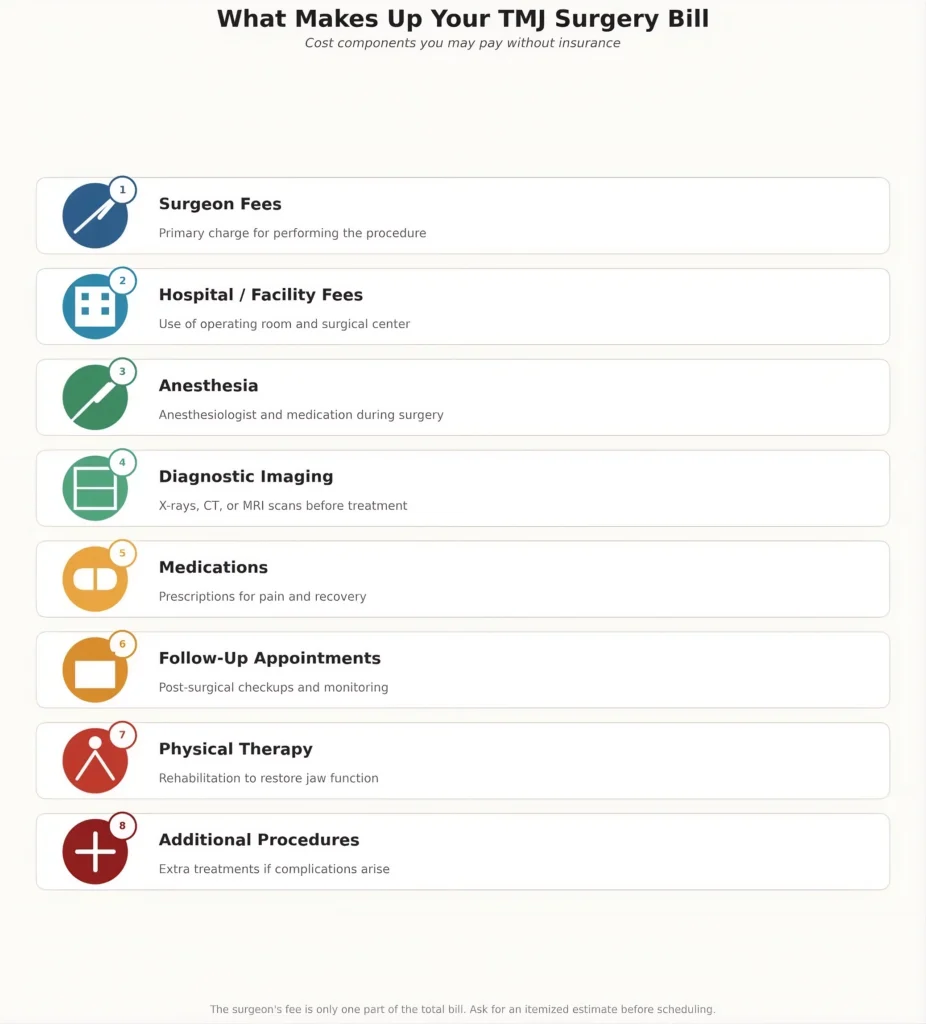
However, the surgeon’s fee is usually only one part of the total bill.
Your TMJ surgery cost without insurance may include:
- Surgeon fees
- Hospital or surgical facility fees
- Anesthesia
- Diagnostic imaging
- Medications
- Follow-up appointments
- Physical therapy or rehabilitation
- Additional procedures or treatments
Published estimates can vary significantly between providers.
For example, Dr. Kevin Gropp’s TMJ treatment cost page discusses some of the factors that can affect TMJ treatment and surgery pricing.
Keep in mind that published figures are general examples, not guaranteed prices for your particular treatment.
If you are paying without insurance, ask the provider for a written, itemized estimate before scheduling surgery. You may also want to ask whether the provider offers a self-pay rate or payment plan.
TMJ Surgery Cost With Insurance
Having insurance can reduce your out-of-pocket cost, but insurance does not automatically mean TMJ surgery will be covered.
Your TMJ surgery cost with insurance can depend on several factors, including:
- The exact procedure being performed
- Your diagnosis
- Whether the procedure is considered medically necessary
- Your insurance plan
- Whether the surgeon is in network
- Whether the facility is in network
- Whether prior authorization is required
- Your remaining deductible
- Coinsurance or copay requirements
- Coverage exclusions or limitations
- Your plan’s out-of-pocket maximum
The TMJ Association notes that insurance coverage for TMJ treatment can vary substantially between plans and that some policies may exclude certain TMJ treatments. See the TMJ Association’s information about TMJ treatment costs and insurance for additional background.
Does Medical Insurance Cover TMJ Surgery?
It depends on your insurance plan and the specific procedure.
Some medical insurance plans may cover certain TMJ procedures when they meet the plan’s requirements for medical necessity. Other plans may exclude particular TMJ treatments.
Because insurance policies differ, don’t rely on a general statement such as “TMJ surgery is covered.”
Instead, ask your insurer about the specific procedure and billing codes your surgeon plans to use.
You should also ask whether prior authorization is required before the procedure.
Does Dental Insurance Cover TMJ Surgery?
Dental insurance may cover certain TMJ-related services under some plans, but coverage varies considerably.
One complication is that some TMJ conditions and treatments can fall between medical and dental insurance coverage. As a result, patients may need to determine whether their medical insurance, dental insurance, or neither will provide coverage.
Before surgery, check both policies when appropriate and ask each insurer to explain the coverage rules for your particular procedure.
How Much Will You Pay Out of Pocket With Insurance?
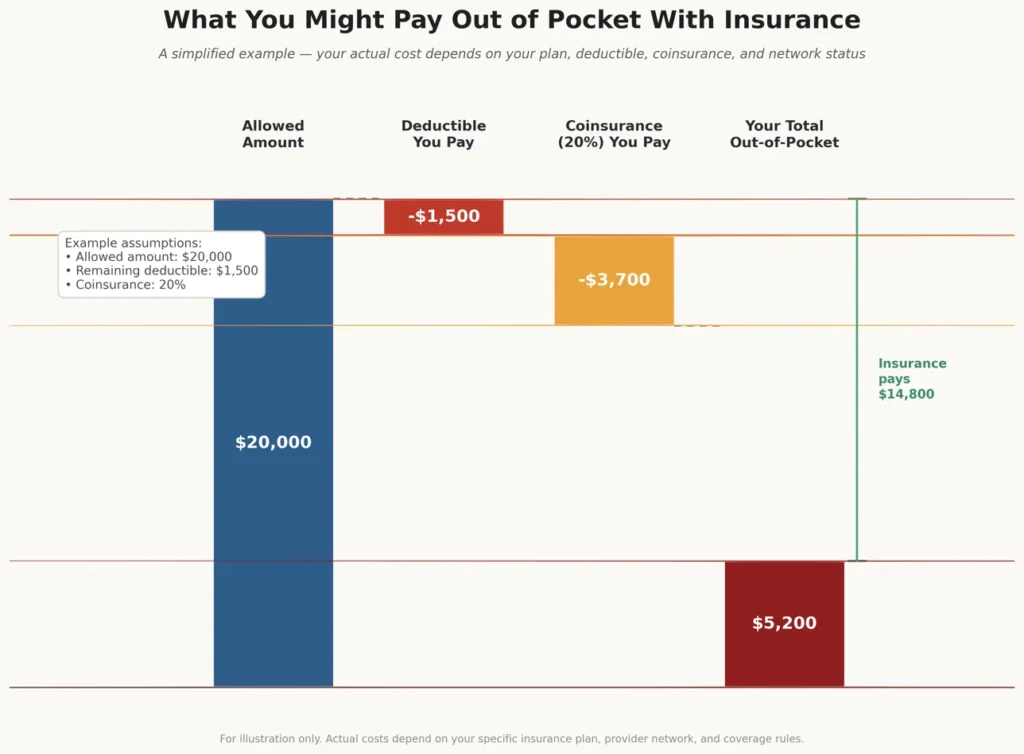
Your out-of-pocket cost is not necessarily the same as the provider’s advertised price.
For example, suppose:
- Allowed amount: $20,000
- Remaining deductible: $1,500
- Coinsurance: 20%
In a simplified example, you would first pay the applicable deductible and then your coinsurance on the remaining covered amount, subject to the rules of your insurance plan.
However, your actual cost could be very different depending on:
- Your insurance plan
- The insurer’s negotiated rate
- Whether the provider is in network
- Coverage exclusions
- Your out-of-pocket maximum
- Whether the entire procedure is considered covered
Whenever possible, ask your insurance company for a pre-treatment estimate and ask your surgeon’s office for an itemized estimate of the expected charges.
What Can Cause Insurance to Deny TMJ Surgery?
Insurance companies can deny TMJ-related claims for several reasons.
Possible reasons include:
- The treatment is excluded under the policy
- Insufficient documentation of medical necessity
- Coding issues
- Failure to obtain prior authorization
- Treatment limitations
- The procedure does not meet the plan’s coverage criteria
If your claim is denied, ask your insurer for the specific reason for the denial in writing.
You can also ask your surgeon’s office whether they can provide medical records or other supporting documentation for an appeal.
The TMJ Association provides additional information about TMJ treatment costs and insurance considerations.
What Factors Affect TMJ Surgery Cost?
Several factors can change your final TMJ surgery bill.
Type of Procedure
Arthrocentesis, arthroscopy, open-joint surgery, and TMJ replacement have different levels of complexity and therefore can have very different costs.
Severity of the Condition
More complex cases may require additional procedures, longer treatment, or more extensive follow-up care.
Surgeon and Location
Prices can vary substantially depending on the surgeon, geographic area, hospital, and surgical facility.
Facility and Anesthesia
A hospital or surgical center may charge separate facility and anesthesia fees.
Insurance Status
Your deductible, coinsurance, network status, coverage limitations, and out-of-pocket maximum can significantly affect what you actually pay.
Additional Treatment
Imaging, medications, dental appliances, physical therapy, and other treatments can add to the overall cost.
How to Lower Your TMJ Surgery Costs
Before scheduling surgery, ask for an itemized treatment estimate.
You should also verify:
- Whether the surgeon is in network
- Whether the facility is in network
- Whether anesthesia is covered
- Whether prior authorization is required
- Whether your insurance plan has TMJ exclusions
- Whether the provider offers a self-pay discount or rate
- Whether financing options are available
- Whether a payment plan is available
When appropriate, you can also compare estimates from qualified TMJ specialists.
However, the lowest price should not necessarily be the deciding factor for a major surgical procedure. Consider the surgeon’s qualifications, the recommended procedure, expected outcomes, risks, and your overall treatment plan.
Do You Actually Need TMJ Surgery?
Cost is only one part of the decision.
Before agreeing to surgery, discuss why the procedure is being recommended and whether less-invasive alternatives may be appropriate for your particular condition.
Consider asking your healthcare provider:
- Why do I need this specific procedure?
- What happens if I don’t have surgery?
- Are there nonsurgical alternatives?
- What are the risks?
- What will recovery involve?
- What is the estimated total cost?
- How much is expected to be covered by insurance?
For major surgery, obtaining a second professional opinion may also be appropriate.
Questions to Ask Before Scheduling TMJ Surger
Questions to Ask Your Surgeon
- What type of TMJ procedure am I having?
- What is the estimated total cost?
- Does the estimate include anesthesia?
- Does it include facility fees?
- Will I need additional imaging or treatment?
- What follow-up costs should I expect?
- Are there less-invasive alternatives?
Questions to Ask Your Insurance Company
- Is this exact procedure covered?
- Is it considered medical or dental treatment under my plan?
- Do I need prior authorization?
- Is my surgeon in network?
- Is the surgical facility in network?
- What is my remaining deductible?
- What coinsurance or copay will apply?
- Is there a TMJ exclusion or treatment limit?
- What is my estimated out-of-pocket cost?
- What is the appeals process if my claim is denied?
Frequently Asked Questions
How much does TMJ surgery cost without insurance?
There is no single price for TMJ surgery without insurance. Published estimates can range from several thousand dollars to $50,000 or more, depending on the procedure, complexity of the case, provider, location, facility, and other factors.
How Much Does TMJ Surgery Cost With Insurance?
Sometimes. Coverage depends on your insurance company, specific plan, procedure, medical-necessity requirements, network status, and individual circumstances.
Is TMJ surgery covered by medical or dental insurance?
It can be covered by either medical or dental insurance depending on the procedure and the terms of the plan. Some patients may need to check both their medical and dental insurance policies.
Why is TMJ surgery so expensive?
The total cost can include surgeon fees, facility fees, anesthesia, imaging, medications, follow-up care, rehabilitation, and other treatment. More complex procedures generally require more resources and may therefore cost more.
What is the cheapest TMJ surgery?
Less-invasive procedures such as arthrocentesis may cost substantially less than open-joint surgery or TMJ replacement. However, the actual price depends on the provider, location, procedure, and individual circumstances. The cheapest procedure is not necessarily appropriate for every patient.
What if my insurance denies TMJ surgery?
Ask the insurer for the specific reason for the denial and request the information in writing. Review your policy, ask your healthcare provider for supporting documentation, and follow your insurer’s appeal process.
Bottom Line
TMJ surgery can cost several thousand dollars to $50,000 or more, but there is no single price that applies to everyone.
f you’re trying to determine your TMJ surgery cost with insurance, the most reliable approach is to obtain an itemized estimate and confirm your benefits directly with your insurer.
Your final TMJ surgery cost with insurance can depend on your specific procedure, insurance plan, deductible, coinsurance, network status, coverage limitations, and out-of-pocket maximum.
Before scheduling treatment, get an itemized estimate from your healthcare provider and confirm your expected coverage directly with your insurance company.
You May Also Like: How Much Are Braces Without Insurance? 2026 Best Cost Guide
Medical and Cost Disclaimer
Cost estimates and insurance information in this article are provided for general informational purposes and may not reflect your actual treatment cost or insurance benefits. Insurance policies and coverage rules can change, and coverage decisions are made by individual insurers.
This article does not provide medical advice, diagnosis, treatment recommendations, insurance advice, or financial advice. Speak with a qualified healthcare professional about whether TMJ surgery is appropriate for you, and contact your insurance company for current, plan-specific coverage and cost information.
Leave a Reply