Thinking about straightening your teeth but don’t have dental insurance? You’re probably wondering how much you’ll actually need to budget.
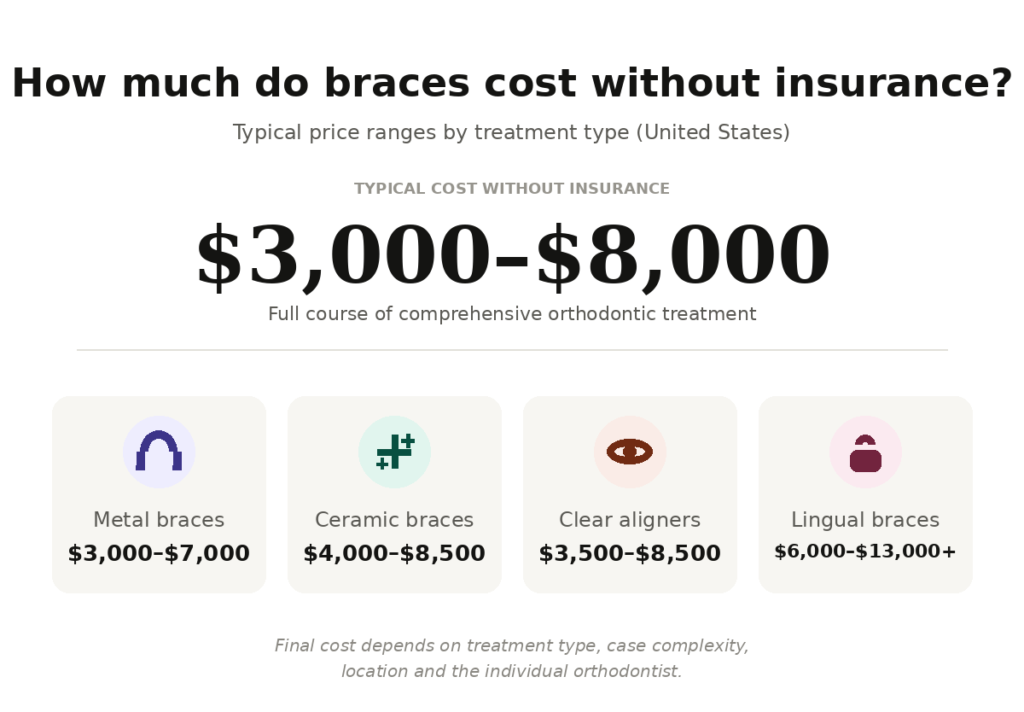
In the United States, a full course of braces without insurance can cost roughly $3,000 to $8,000, although the price can be lower for simpler cases and considerably higher for complex or specialized treatment.
Traditional metal braces commonly fall around $3,000 to $7,000, while ceramic braces and clear aligners can cost roughly $4,000 to $8,500. Lingual braces, which are attached to the back of the teeth, can cost $6,000 to $13,000 or more.
There isn’t one fixed price for braces. Your final cost depends on the type of treatment, the complexity of your case, where you live, how long treatment takes, and what your orthodontist includes in the treatment fee.
The good news is that you usually don’t need to pay the entire amount upfront. Many orthodontic offices offer payment plans that divide the cost into a down payment and monthly installments.
Braces Cost Without Insurance at a Glance
| Treatment Type | Typical Cost Without Insurance |
|---|---|
| Traditional metal braces | $3,000–$7,000 |
| Ceramic braces | $4,000–$8,500 |
| Clear aligners | $3,500–$8,500 |
| Lingual braces | $6,000–$13,000+ |
These figures are general planning ranges rather than guaranteed prices. The American Association of Orthodontists explains that orthodontic fees can vary depending on factors such as treatment complexity, location and the individual orthodontist.
How Much Do Braces Cost Without Insurance?
For many patients, a reasonable budget for comprehensive orthodontic treatment is around $4,000 to $7,000.
However, it’s better to think in terms of a range than one national “average.” A patient with mild crowding may need a simpler treatment plan than someone with a significant bite problem or severe tooth misalignment.
Location can make a difference too. For example, Zocdoc’s Chicago braces guide reports prices in the area ranging from roughly $3,000 to $7,500.
So if one orthodontist quotes you $4,500 and another quotes $6,000, the difference doesn’t automatically mean one office is overcharging. The treatment plans may not be identical.
The American Association of Orthodontists also points out that there is no single price that applies to every orthodontic patient because treatment is individualized.
How Much Does Each Type of Braces Cost?
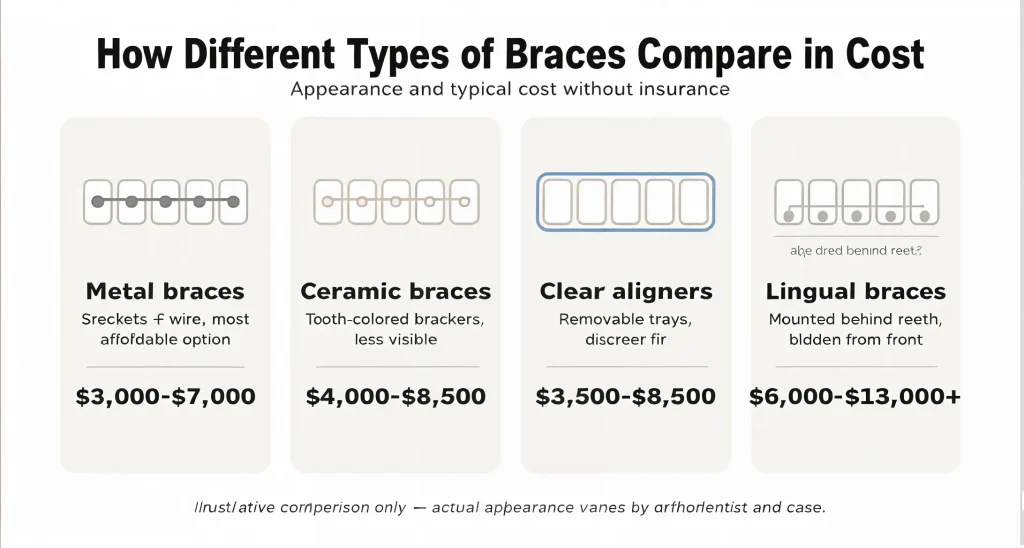
The type of treatment you choose can significantly affect the overall cost of braces without insurance.
Traditional Metal Braces: $3,000–$7,000
Traditional metal braces are generally one of the most affordable fixed-brace options.
They use brackets attached to the teeth and wires that are adjusted throughout treatment to gradually move the teeth into better positions.
Metal braces can treat a wide range of orthodontic problems, which is one reason they remain so common.
If keeping your treatment cost as low as reasonably possible is your main priority, metal braces are worth asking about first.
Ceramic Braces: $4,000–$8,500
Ceramic braces work similarly to traditional metal braces, but the brackets are designed to blend more closely with the color of your teeth.
Their less noticeable appearance can make them appealing to adults and teenagers who don’t want prominent metal brackets.
That cosmetic advantage can come with a higher price, however.
Clear Aligners: $3,500–$8,500
Clear aligners use a series of removable trays instead of traditional brackets and wires.
They’re discreet and convenient for many patients, but don’t assume they’re automatically cheaper than braces.
The American Association of Orthodontists recommends having an orthodontist evaluate your individual situation to determine whether aligners are an appropriate treatment option.
Lingual Braces: $6,000–$13,000+
Lingual braces are attached to the back of the teeth, which makes them much less noticeable from the front.
Because they require specialized placement and customized hardware, they can cost significantly more than conventional braces.
A higher price doesn’t necessarily mean a better result. The right treatment depends on your orthodontic needs, not simply the cost of the appliance.
How Much Are Braces Per Month Without Insurance?
Looking at the total price of braces can be intimidating, but monthly payment plans can make the expense easier to manage.
For example, imagine an orthodontist quotes $6,000 for your complete treatment. If you paid the entire amount over 24 months with no down payment, interest or additional fees, your payment would be:
$6,000 ÷ 24 = $250 per month
Here’s what different treatment totals would look like over 24 months:
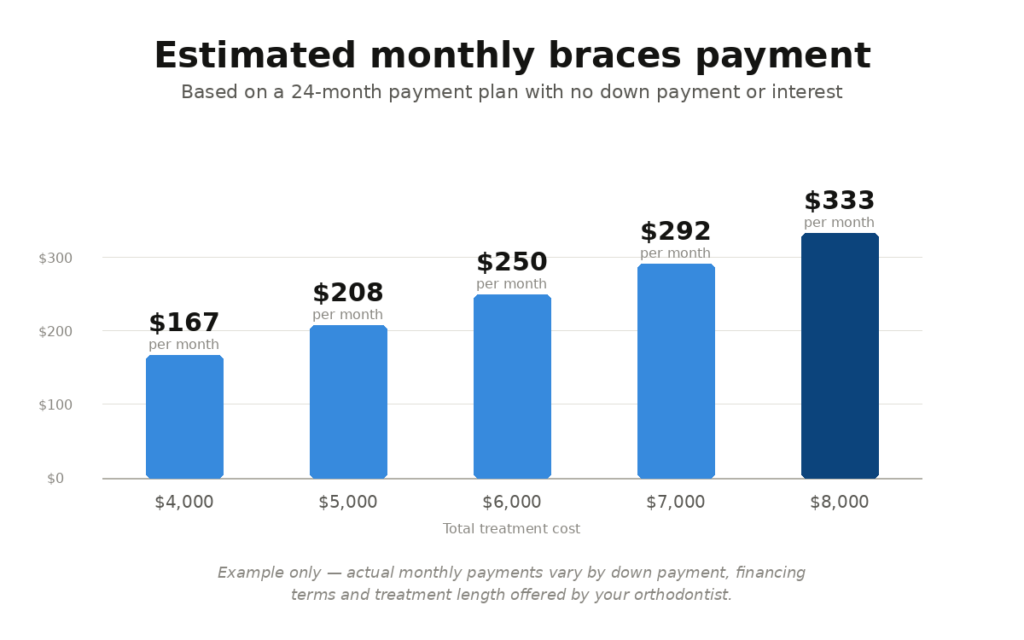
These are simple examples rather than actual financing offers. Real payment plans may involve a down payment, different repayment periods, interest or financing fees.
For example, if your treatment costs $6,000 and you pay $1,000 upfront, you would have $5,000 remaining. Spread over 24 months with no interest, that would work out to approximately $208 per month.
The American Association of Orthodontists notes that many orthodontists offer payment plans, although the terms vary between practices.
What Is Usually Included in the Cost of Braces?
Before committing to braces without insurance, ask the orthodontist exactly what is included in the quoted treatment fee.
Depending on the practice, the treatment fee may include:
- Initial examination
- Diagnostic records
- X-rays or scans
- Brackets and wires
- Adjustment appointments
- Removal of braces
- Retainers
- Follow-up visits
Don’t assume all of these services are automatically included.
The AAO recommends asking your orthodontist what the quoted fee covers and whether any services are excluded.
For example, one office might quote $5,500 and charge separately for retainers, while another might quote $6,000 but include the retainers and adjustment appointments.
That means the lowest advertised price isn’t necessarily the lowest overall cost.
What Extra Costs Can Increase Your Braces Bill?
The price of the braces themselves isn’t always the entire cost of braces without insurance.
Depending on your situation, you may also need to budget for:
X-rays and Diagnostic Records
Your orthodontist may need panoramic X-rays, photographs, scans or other diagnostic records before creating your treatment plan.
Tooth Extractions
Some patients with significant crowding may need one or more teeth extracted before or during orthodontic treatment.
Expanders and Other Appliances
Certain bite or jaw problems may require an expander or another orthodontic appliance in addition to braces.
Replacement Retainers
Retainers are important for maintaining your results after active treatment. Ask whether your initial retainers are included and what replacement retainers cost.
Repairs or Emergency Visits
Broken brackets, damaged wires or other problems can sometimes result in additional appointments or charges, depending on your orthodontist’s policy.
What Determines the Cost of Braces?
When you’re paying for braces without insurance, understanding these factors can help you compare quotes more accurately.
Treatment complexity: A simple case of mild crowding may cost less than treatment involving significant bite correction.
Type of treatment: Metal braces, ceramic braces, clear aligners and lingual braces have different costs.
Treatment duration: A longer treatment plan may involve more appointments and adjustments.
Location: Orthodontic prices can vary considerably between cities and regions.
Orthodontist and practice: Office overhead, technology, experience and pricing structure can all affect the quote.
Additional procedures: Extractions, expanders and other appliances can increase your overall treatment cost.
Example: What a $6,000 Braces Treatment Could Look Like
Here’s a simple hypothetical example.
Suppose Sarah visits an orthodontist and receives a $6,000 treatment quote.
The office asks for a $1,000 down payment and allows her to pay the remaining $5,000 over 24 months with no interest.
Her estimated monthly payment would be:
$5,000 ÷ 24 = $208.33 per month
So Sarah doesn’t necessarily need $6,000 sitting in her bank account on the day she starts treatment.
This is why it’s important to ask about both the total treatment cost and the payment structure.
A slightly more expensive treatment plan with a manageable down payment could be easier to afford than a cheaper plan that requires a large upfront payment.
How Can You Get Braces for Less Without Insurance?
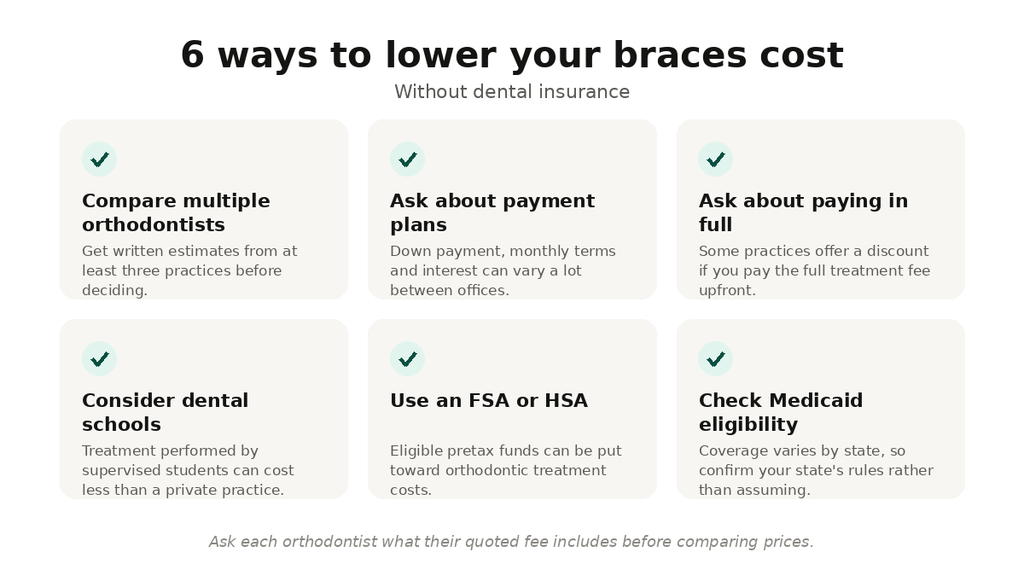
Comparing several orthodontists is one of the simplest ways to find more affordable braces without insurance.
Compare Multiple Orthodontists
Try to get estimates from at least three orthodontic practices when possible.
Ask each office for a written treatment estimate so you can compare the total cost and what’s included.
Ask About Free Consultations
Some orthodontists offer free or low-cost initial consultations. Ask about the consultation fee before booking.
Compare Payment Plans
Don’t just ask, “How much are braces?”
Also ask:
- How much is the down payment?
- How long can I spread out the payments?
- Is there interest?
- Are there financing fees?
- What happens if treatment takes longer than expected?
Ask About Paying in Full
Some practices may offer a discount if you pay the entire treatment fee upfront.
It doesn’t hurt to ask, although you should compare the discount with the amount of money you’d have to pay immediately.
Consider Dental Schools
Dental schools can sometimes provide orthodontic treatment at a lower cost because treatment is performed by dental students under professional supervision.
Zocdoc also identifies dental schools as one potential option for people looking for lower-cost orthodontic care.
Use an FSA or HSA If You’re Eligible
If you have access to a Flexible Spending Account or Health Savings Account, eligible funds may be used toward orthodontic treatment.
The American Association of Orthodontists provides additional information about using these accounts for orthodontic expenses.
Check Medicaid Eligibility
Medicaid orthodontic benefits vary by state and eligibility requirements.
Some children and qualifying patients may receive orthodontic coverage when treatment meets specific requirements, so check your state’s Medicaid rules rather than assuming you’re automatically excluded.
Do Braces Cost More for Adults?
Not necessarily.
Adults can receive many of the same orthodontic treatments available to teenagers, although their individual treatment plans may differ.
Adult teeth can sometimes take longer to move because the supporting bone is more established. Adults may also choose cosmetic options such as ceramic or lingual braces, which can increase the price.
Insurance is another important consideration.
Some dental plans provide orthodontic benefits for adults, while others only cover children or teenagers. If you have dental insurance, check the plan’s orthodontic benefits, age restrictions, waiting periods and lifetime maximum before assuming you’ll receive coverage.
Questions to Ask Before Paying for Braces
Before signing a treatment agreement, ask your orthodontist:
- What is the total cost of treatment?
- What services are included?
- Are X-rays and diagnostic records included?
- Are adjustment appointments included?
- Are retainers included?
- How much is the down payment?
- What will my monthly payment be?
- Is the payment plan interest-free?
- Are broken brackets or emergency visits charged separately?
- What happens if treatment takes longer than expected?
Whenever possible, get the answers in writing.
How Much Should You Budget for Braces Without Insurance?
Having a realistic budget for braces without insurance can help you avoid unexpected expenses during treatment.
- Lower-cost treatment: $3,000–$4,500
- Common planning range: $4,000–$7,000
- Higher-end treatment: $7,000–$10,000+
- Specialized treatment such as lingual braces: $10,000+
These are planning estimates, not guaranteed prices.
Your actual cost will depend on your treatment needs, location and orthodontist.
The Bottom Line
If you’re considering braces without insurance, getting a detailed treatment estimate before starting can help you understand the full financial commitment.
So, how much are braces without insurance?
For many people in the United States, a reasonable starting budget is around $3,000 to $8,000 for comprehensive orthodontic treatment.
Traditional metal braces are generally toward the lower end, while ceramic, clear-aligner and lingual treatments can cost more.
But don’t choose an orthodontist based solely on the lowest advertised price.
Ask for the total treatment cost, down payment, monthly payment, expected treatment length and everything included in the fee.
A $6,000 treatment plan with a manageable payment schedule may be more practical than a $5,000 plan with a large upfront payment and several additional fees.
The goal isn’t simply to find the lowest advertised price. It’s to find the lowest realistic total cost for the treatment you actually need.
Frequently Asked Questions
Can I get braces without dental insurance?
Yes. Dental insurance isn’t required to receive orthodontic treatment. You can pay out of pocket, use a payment plan, or potentially use eligible FSA or HSA funds.
What is the cheapest type of braces?
Traditional metal braces are generally one of the most affordable fixed-brace options.
How much are braces per month without insurance?
The monthly cost of braces without insurance depends on the total treatment price, down payment and payment period. For example, $6,000 spread over 24 months with no interest would equal $250 per month.
Are braces cheaper at a dental school?
They can be. Dental schools may offer reduced-cost treatment under professional supervision, although treatment may take longer.
Does dental insurance have to cover braces?
No. Orthodontic coverage isn’t included in every dental plan. Plans that do provide coverage may have age restrictions, waiting periods, percentages or lifetime maximums.
Are retainers included in the cost of braces?
Not always. Some orthodontists include the first set of retainers, while others charge separately. Ask before accepting your treatment quote.
How long do braces usually take?
Many orthodontic treatments take roughly 12–24 months, although the timeline depends on the complexity of your case and the treatment approach.
Is Invisalign cheaper than braces?
Not necessarily. Clear aligners can cost about the same as traditional braces or more, particularly when treatment is complex.
You May Also Like ; Is GAP Insurance Worth It? The Complete Guide to Pros, Cons & Costs
Sources and Further Reading
For information about orthodontic costs, payment plans and treatment considerations, see the American Association of Orthodontists’ braces cost and financing resources.
For a location-specific example, Zocdoc’s Chicago braces cost guide provides local price ranges and discusses payment options and lower-cost alternatives.
Leave a Reply